*
The Moat and the Fog
Why the bill dies off-camera, and why the 119th Congress feels like the lowest-effort endpoint yet
We click on Cable News, social media, and Local News the way our grandparents flipped on the radio: to hear the country happen in real time.
For a second, it sometime hits the C-SPAN address. The blue carpet. The desks. The little flags. The dais like an altar. A gavel that means order.
Then the strangest part lands.
There’s no one on stage.
No Senator holding the floor. No marathon speech. No sweaty, cinematic obstruction. Just a chamber that looks like a theater between matinee and night show >> lights up, audience gone, actors missing.
Meanwhile, somewhere off-screen, a bill is being quietly strangled.
Opening scene: the bill as a living thing
Picture the bill as someone with a pulse. Not “H.R. 7147.” A living thing: DHS, insulin, rail safety, childcare, whatever the country told itself it needed this year.
It arrives at the Senate doors expecting a fight in public.
Instead, it meets a stage manager with a clipboard and one question:
“Do you have 60?”
If the answer is no, the bill doesn’t lose in debate. It doesn’t lose in a vote. It doesn’t even lose with dignity.
It just… waits. Then it expires.
And the chamber stays pretty.
That’s the first trick of the modern Senate: the real choke point isn’t a speech. It’s the wall behind the curtain.
The 119th Congress: the lowest-effort version yet
The standing, talking filibuster is still technically possible. The old myth still exists > heroic obstruction, bodies on the floor, the whole chamber held hostage by a single voice.
But the 119th Congress lives by a different norm, the lowest-effort endpoint of that evolution:
legislation can be halted without anyone showing up on the floor
the majority still must find 60 votes even when no one is speaking
obstruction becomes invisible, frictionless, and nearly cost-free
This is the opposite of the pirate-era metaphor that gave the filibuster its romance. There’s no raiding the process anymore, just procedural inertia. A ship doesn’t get boarded. It just never leaves port.
And that’s not a quirk. It fits the larger machine perfectly.
Section 1 => The Moat
Why incumbents can tolerate paralysis
Now we pan away from the chamber and look at the castle.
Incumbency isn’t merely being “well-known.” It’s a structural head start: a moat filled with resources, routine visibility, and the quiet advantage of seeming inevitable.
The moat is made of small reinforcements that add up:
staff capacity that turns problems into solved cases
office resources that keep a name everywhere, all the time
constituent service that builds gratitude one file at a time
communications channels that blur the line between “informing” and “branding”
the soft deterrent that convinces strong challengers to run somewhere else
Survival becomes easier inside the walls.
And once survival is easier, risk starts to feel optional.
Section 2 => The Fog
How obstruction stopped looking like obstruction
Back to the empty stage. The obvious question hangs there:
If no one is speaking, how is the bill being blocked?
Welcome to the fog.
In practice, the fight often shifts from “Can you defend this in public?” to the colder gatekeeping question: “Can you assemble 60?” The chamber can keep moving on other tracks while one bill quietly starves.
Fog does three things, every time:
It hides the hand. Who did it? Harder to see.
It blurs the motive. Principle, leverage, revenge, a donor signal > take your pick.
It cheapens obstruction. No need to prepare arguments, hold the floor, or defend a position.
So the bill doesn’t die on the merits.
It dies in the hallway, behind a door labeled “procedure,” while the cameras broadcast an empty room like a screensaver.
Moat + Fog
The incentives click into place
Put the moat and the fog in the same room and the system becomes grimly efficient:
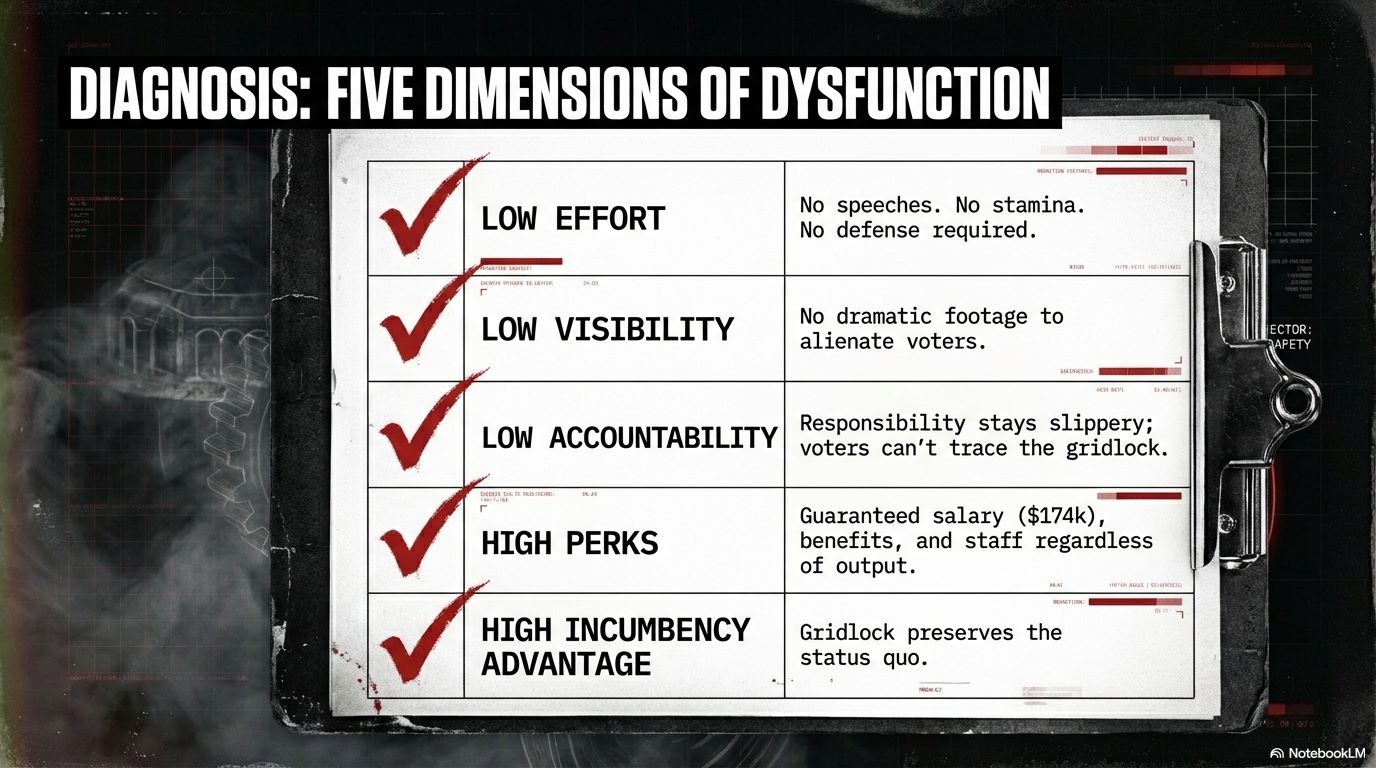
Low effort: no speeches, no stamina, no defense required
Low visibility: no dramatic footage that risks alienating voters or donors
Low accountability: the block happens off camera, so responsibility stays slippery
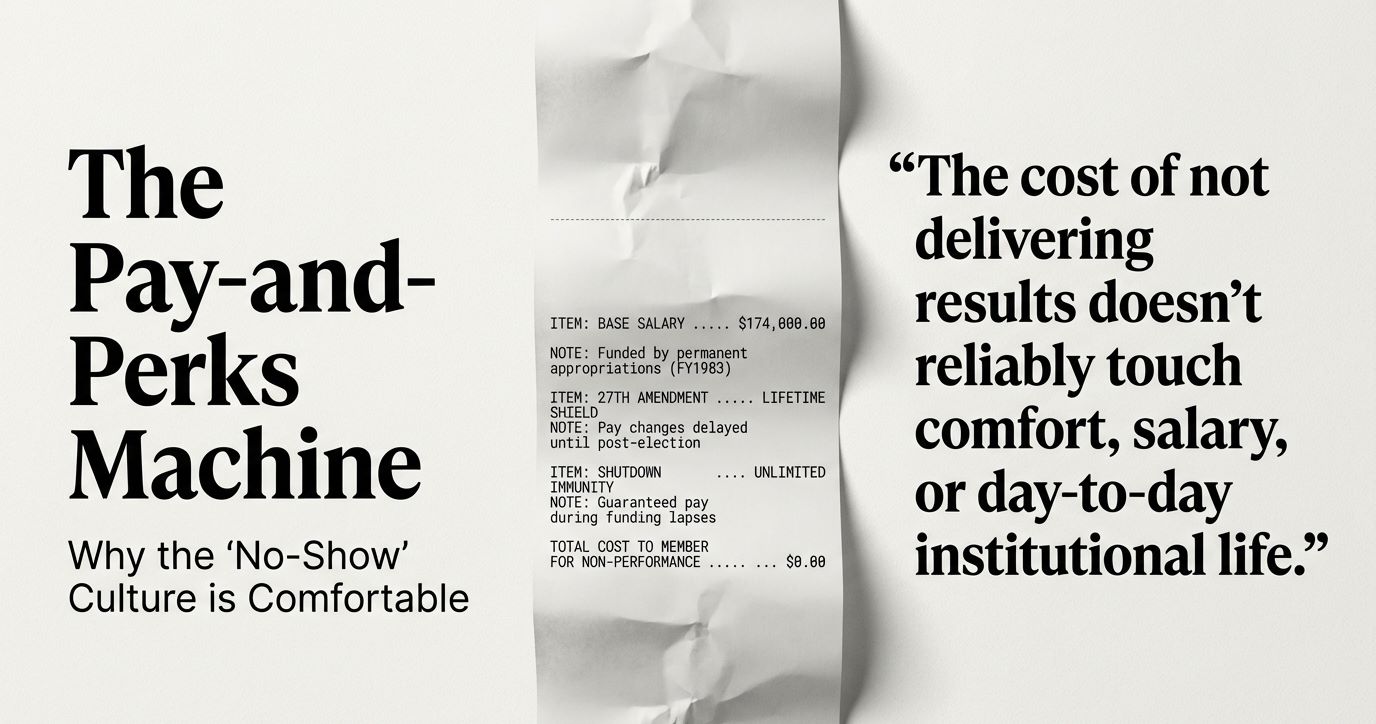
High protection of perks: salary, benefits, staff, seniority continue regardless of output
High incumbency advantage: gridlock preserves the status quo, which tends to protect the already seated
In other words, the modern filibuster is perfectly adapted to a career-oriented, risk-averse Congress: the benefits of office are guaranteed; the labor of governing is optional.
The institution has drifted from “heroic obstruction” to procedural non-participation.
The moat stays filled.
The fog stays thick.
The stage stays empty.
The back hallway
How “full control” doesn’t need to announce itself
This is where the deeper storyline snaps into focus, without needing a cartoon villain.
When the public sees only the stage, power can live comfortably in the hallway.
Money gets the first meeting.
Media decides what counts as real.
Procedure decides what can move.
Technology can tailor persuasion at scale.
Assets anchor ownership.
None of this needs to shout. It only needs the camera aimed at the wrong door.
Put everyone on notice
These aren’t “nice ideas.” They’re accountability demands.
If you block the nation’s work, do it in public; on the floor > by name.
If 60 votes are required, show who forced that threshold, and why.
If incumbency advantage rests on office resources, audit how those resources protect careers.
What we demand next
Concrete, structural, aligned with the incentives:
A commitment-based filibuster
Continuous presence and sustained debate to maintain a block > so obstruction costs time, not just a threat.Public accountability for obstruction triggers
Standardized reporting on holds, objections, and cloture triggers; plain language, names attached >> so the camera stays on.Audit the moat
Measure how official resources translate into electoral insulation, then set guardrails where public tools become private advantage.Trace the chain
Donor pressure > lobbying > media framing > procedural action > outcome. Receipts, not folklore.
Closing line
If you’re going to stop the country >> show up, speak up, and sign your name.